Email this article to a friend
Interview with Chris Hancock
By Angela Stengel
One weekend. Nine artists. No licensed venues and no backyard parties. Could you do it? Due to the rising number of artist-run spaces in Sydney, it’s now an easy challenge to accept. You can start at Space 3 – once a bank – on Cleveland Street, in inner-city suburb Redfern, for an early session of indie, electronic or something in-between. Then you could head to Yvonne Ruvé for a cosy late night of some more experimental sounds. And you could even walk along the corridor and stick you head into the Frequency Lab space located in the same building on Elizabeth Street in Surry Hills.
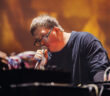
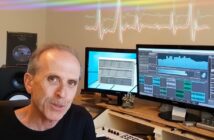
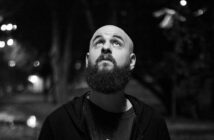
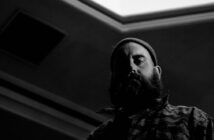
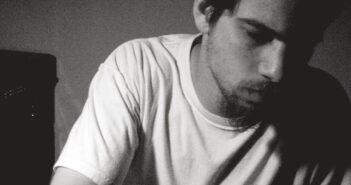
If you peer into the Frequency Lab on any night of the week, you’ll most likely find Monkfly, or Chris Hancock to his friends. He was one of the people who started the Frequency Lab space a few years ago. ‘We were sitting next door and the radio was on,’ he says. ‘We were banging away on our music and graphics and stuff and we were a bit stunned. It was one of those Alternative Lectures on community radio station 2SER – a Canadian guy called Amiri Baraka talking about this poetry club that he and his wife run. Matt (who also runs the space) and I had been speaking about how Sydney is boring and then we heard this news about a poetry club. Baraka was saying, “It holds 60 in the main room and we’ve had to open up the second room which holds 20 standing, and with the windows open another 10 people are able to participate.” We found it fascinating. He finally came to the point that he was talking about his own house, and as a result of wanting to see things change and a desire for a performance space, just thought, “Why can’t I use this space?” We were living next door to what’s now the Frequency Lab, in a warehouse, and looking at our space thinking it’s ridiculous to be complaining about the state of things when really – maybe having to do it illegally initially – there’s no reason not to be putting as much culture forward as we can. Our housemates at the time felt slightly differently so we ended up moving in here, getting the lease here and setting up this space.’
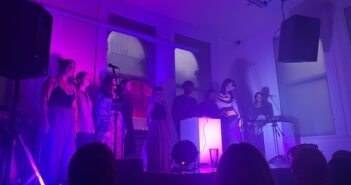
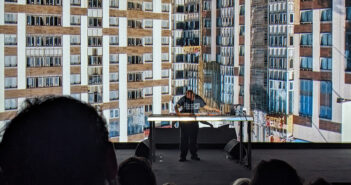
Since Hancock and his warehouse cohorts opened their doors, people have come to improvised music nights, drum‘n’bass parties, spoken word events, film talks and gallery openings. Each type of event brings with it a different mood and a different type of audience. ‘Opening your door to a whole bunch of people is a scary thing. It’s a beautiful thing as well, because it assumes that your fellow woman and man are sensible and don’t want to destroy things. Sometimes we open the door and just see idiots tearing things apart. Other times a full house of 200 come in and the place is spotless when they leave and you just think that people can be so lovely and respectful. I’m always amazed by how much silence can be found in the audience when there’s a performance on here. Even on the Token Word poetry nights you’ll have 150 people slowly getting pissed and they’re all quiet – just listening to the ones out the front shouting out their latest rhyme or poem. It’s fantastic.’
Entering an artist-run space means going into a world where entry and beers are by donation, the artists rise from their cushion in the crowd to perform, hefty bouncers don’t hover at the door, and the act – not drinking or socialising, although these are equally important – is always given the most respect and focus.
‘There’s a good lot of good people in Sydney,’ muses Hancock over his coffee and hand-rolled cigarette. ‘You’ve just gotta put them into different environments and people are people again. After having played in bands to three old alcoholic dudes at a bar and thinking, “This isn’t a respectful environment.” You can’t experiment in that sort of environment.’
He goes on to talk about legendary musician John Cage, and it is clear that the idea of controlling a space for music and art to exist without the usual capitalist approach wasn’t new to him. ‘I was lucky enough to do some musical study at the University of Western Sydney and read about characters like Cage and people like that who had a really big emphasis on setting up a different context for music to be digested in. Then, potentially, you can have different forms of digestion and a space for different music to emerge. Sometimes music is context specific. You can’t necessarily come into a club and do this because people are there with a certain assumption.’
The live music situation in Sydney is a sad and tired topic. Venues come and go, and it is rare that a good one will stick around for long before turning into a place for commercial house music or Irish bands. The lack of good music venues was part of the reason for the Frequency Lab starting. ‘A lot of Sydneysiders had been complaining about the nature of Sydney and how generally boring and commercial it was,’ says Hancock. ‘It’s difficult to get stuff out there that you believe in and have nights without the economic rationalist angle: pack the club and make it as commercially viable as possible.’
But even in the warehouse business, there is still a need to think about running a venue that can be economically successful. ‘When we first opened up I had to do parties pretty solidly to just get the capital in so we could have the time and space to do more fringe stuff and not have to make as much money.’
There has been an emergence of venues that fill the void between large licensed venues and artist-run spaces of late; places like Spectrum on Oxford Street and The Kirk in Surry Hills. Hancock is not surprised by this trend. ‘I think it’s a realistic thing. Sydney is overcharged and overpriced. It is necessary for the vibrancy of the city and the community to have these cultural bits accessible and therefore, we can’t do the usual massive club size, but we can tuck Spectrum in upstairs where another bar that generally doesn’t get used is. And there’s still the banging club downstairs with its usual clientele.’
Those ‘usual clientele’ may never get to hear the music Hancock makes under the name Monkfly, but if they did, there is a good chance they would like what they heard. While his recent first album Signore Baffone is an eclectic mix of sounds and genres, there is the odd dance tune that could get anyone into a dancing, partying mood. ‘I’ve always been searching for music that is authentic for me,’ he says on the topic of his new album. ‘What I’ve created on the album is the only thing I could honestly contribute. I love all the tear outs of drum‘n’bass and the fat hiphop music that’s around. I love all the stuff that the [Australian independent label] Elefant Traks lads do. But, to me, that’s not honest from my perspective because my ears do seek out other sounds as well, like a lot of the stuff that comes through here. Seeing that at the end of the day it was more about community it doesn’t matter what music there is unless it actually speaks to people. I’m a bit of a perfectionist as well, so this is the first time I’ve worked in a public space making music, so that definitely influenced it. I probably wouldn’t have said it’d be done for another year or two, but people around here would say “Yeah, it’s great, don’t touch it anymore.”’
His album could evoke playfulness in the most sombre person. The opening track, ‘The Stupids’, is a bouncing ska-like tune with Bermuda B playing clarinet and seemingly having a lot of fun with some powerful scatting. ‘Culture’ combines samples from an Alternative Radio lecture (‘Because you cannot allow the institutions created by imperialism to be the only purveyors of culture’) with well-produced smooth bass and tight beats. He’s highly skilled at creating stories in his music through the use of vocal samples and the influences of the musicians who are featured on the album. ‘I’ve always been interested in a whole plethora of music. When characters would come in I’d ask if they’d wanna lay down some keys or something. There’s a piano player who lives upstairs (Campbell McGuiness from Entropic), Donné who was coming through the building, and the poet Jess (who all feature on the album). There are lots of different influences.
‘I remember lyrics from a lady – heard from albums of friends – a lady called Ani di Franco. There’s a tune of hers, I don’t know what it’s called, but she talks about “Whatever happened to the day when a record was a record of time?” To me that’s a lot of what this record is about. The stories are encoded or referenced to the building and the friendships. There’s one tune which unfortunately didn’t get finished, which has my landlord threatening to kick us out. It’ll be on a future thing I guess.’
Living, working and hosting events in a warehouse can have more problems than just the landlord. ‘Before the last drum‘n’bass and jungle party, we had to spend half a week insulating one of the walls just to ensure it would go from start to finish without police turning up. The warehouse has gone through some very rough phases. We wanted to build it all before opening up the doors but being a do-it-yourself project, it sort of established itself at its own pace, financial restrictions being part of that. The first time we opened the door there were half-built walls and it was a great abstract party zone, but particularly hazardous as well.’
As Hancock tells of the early days, morning sunlight streams through the back windows because of an empty block behind the warehouse. On a nearby couch someone is preparing for a fabric-dying class that’s about to begin. ‘Initially Matt and I slept on the floor as we were setting stuff up and building this wall and that wall,’ says Hancock as he points. ‘Then we slowly built ourselves rooms and the end result was to actually turn them into studios. Now there’s a gallery, an office, Matt’s studio, another lady’s digital studio, a sound studio and the performance area.
‘No one really lives here at the moment, but it houses a few people when they’re in between places. Matt and I are fairly resilient people, but after a while, living here got too much. No personal space, but a good lesson. Not something you wanna do for an amazing amount of time. I think we were here for just over a year which is quite surprising in retrospect.’
The building the Frequency Lab calls home, Hibernian House, was built around 90 years ago and has a heritage listing on its steel frame. ‘It’s the first steel frame building and in an amazing location so the owners can’t knock it down at the moment – well, they haven’t found a way around it, or it’s the least of their problems. To some degree the heritage listing protects our future here, however they are doing as little as possible to maintain the building so that will accelerate its falling down, potentially not as long as it would otherwise be. Maybe only a few more years. Or five years. Or maybe a big chunk of it will fall down in the next year.’
Hancock explains the varied and colourful past of the building. At the moment the surrounding levels contain sweatshops and their sounds filter through the ceiling and floor. ‘You can hear the Korean pop music coming from downstairs and the buzzing from all the sewing machines.’ But at the same time, it has always been a hangout of creative types. ‘The landlord acknowledges that there’s been a history of artists in here and that they’re willing to live a little bit dirtier,’ is how Hancock puts it.
But the building gets more bizarre than sweatshops and warehouse parties. ‘This used to be an old dentist,’ notes a bemused Hancock. ‘I don’t know who would come to get their teeth done here. There used to be a false ceiling which we took down because it was a bit too low. That had fluorescent lights. It looked a bit better, but not much. The dentist was in operation until about only a year before we moved in, maybe two years. I’ve had a couple of characters who must only be in their twenties, come in and go, “Oh bizarre, this is where I used to get my teeth done as a kid.”’
ARTIST-RUN SPACES IN INNER-CITY SYDNEY
Frequency Lab
www.the-frequency-lab.com
107/342 Elizabeth St, Surry Hills, NSW
Regular nights:
We Like You (improv sessions)
Token Word (poetry, spoken word and performance galore)
Yvonne Ruve
104a/342 Elizabeth St, Surry Hills, NSW
Space 3
Corner of Cleveland and Regent Sts, Chippendale, NSW
Lanfranchi’s
www.lanfranchis.com
Level 2, 144 Cleveland St, Chippendale, NSW
|