



Issue #012 (September 2005)
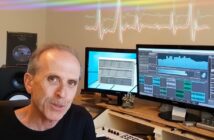
Dave Brown
Email this article to a friend

Interview by Adam Carey

Weird. Difficult. Obscure. Pretentious. Noise. After almost thirty years exploring the margins of what constitutes music, avant-guitarist Dave Brown has learned to live with the bemused responses of the wider public, while slowly but surely carving a formidable reputation among those with an ear for experimental sounds. Long prominent in Australia’s musical underground, Brown is beginning to turn heads overseas too.

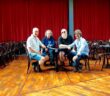
On a chilly April day in North Fitzroy, a crowd of about thirty people has overcome the weather and Sunday afternoon apathy to venture down to the Empress Hotel to watch improv trio Pateras/Baxter/Brown, playing their first Melbourne shows since their European tour late last year.

The trio take to the stage without any fanfare. Drummer Sean Baxter, sitting side on to the audience, cranes his neck to speak.

“Hey dudes, I was gonna stand up and introduce us but the fuckin’ Pope’s dead so now I don’t give a fuck about stuff.”

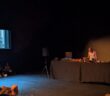
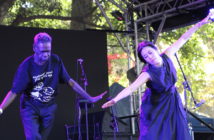
And on that note he starts to play, attacking his drums with what looks like a primitive scrubbing brush and a dented hubcap. Centre stage, Brown sits almost perfectly still, guitar laid flat across his knees. He has attached alligator clips to the strings, and scrapes different objects over them, adjusting the instrument’s tuning all the while, drawing out unearthly sounds. From the side of the stage, Anthony Pateras tip-taps a rapid stream of thin, plinking notes from a prepared piano.

It is intensely tactile music — crackling, crunching, slithering, and creepier than any horror movie score. It is what three errant child geniuses with no previous contact with musical instruments might produce if you locked them away for a week.

But these are not errant child geniuses. They are, in essence, three generations of Melbourne’s musical avant-garde sharing the stage.

For Dave Brown, the trio is merely the latest incarnation of a lifetime’s dedication to musical adventurism. He has been doing this sort of thing since the early 1980s. The younger Baxter joined him in the early 1990s in what has been a fruitful partnership, and Pateras is a 26-year old, classically trained enfant terrible already forging an international reputation through his solo CD Mutant Theatre, released on John Zorn’s Tzadik label in 2004.

There is a long list of musicians eager to work with Brown these days. His crowded résumé also includes roles in jazz/noise quintet Bucketrider, abstract minimalists Western Grey, contemporary classicists Elision Ensemble, and ongoing solo guitar project Candlesnuffer, to name just a few.

But if Brown has assumed some kind of seniority among Australia’s musical avant-garde, he has battled long and hard for it. Circumstances and recurring bouts of self-doubt have often undermined him as he has followed a difficult calling.

Early signs of a musical career weren’t promising. Born in 1956, Brown had a culturally cloistered upbringing, raised by conservative, working class parents in the outer Melbourne suburb of Heidelberg. He learnt the piano for a couple of years as a boy, but says he “just got completely bored” with it.

As a young man his first love was painting. He credits his artistic awakening to an American high school art teacher who shared his enthusiasm for the work of surrealist painters.

“If it wasn’t for him I wouldn’t have known that art schools existed”, he said.

He also joined the high school band, taking up bass guitar because “all the other instruments were chosen.” In true punk spirit, he had no schooling. The other members of the band simply taught him to play the bass parts to suit the chords.
But it wasn’t long before he began developing his own intricate and melodic bass playing style—a style that he said has stayed with him until now.

“As a bass player I was always a bit of a frustrated guitar player”, he said.

After a string of roles in cover bands and art rock bands, Brown had an encounter that could have catapulted him to the apotheosis of rock and roll fame. In 1975, AC/DC moved to Melbourne, searching for a fresh start and a new rhythm section. Brown auditioned to play bass, but his artier musical inclinations clashed with AC/DC’s raw rock sound, and both parties agreed it was not a good fit.

“I was a bit naïve and didn’t understand that pure dirty rock because I was listening to other things,” Brown admitted.

“Only from a completely selfish point of view” does he confess to pondering today how differently his life would have turned out had he got the gig. His childhood friend, Phil Rudd, did, and Brown never heard from him again. (Brown told me, conspiratorially, that his real name is Rudinski.)

Instead of playing riff rock anthems in crowded stadiums around the world, Brown went to art school to develop his painting. There, he formed the group Signals with fellow students David Wadelton and Chris Knowles.

“Very early on it was a noise band, but we had no notion of noise music”, he said. “We’d do things like stand three guitars against amplifiers and turn them on and let them run for fifteen minutes, and that was a performance.”

Signals joined a community of like-minded groups including Tic Tic Tic, Essendon Airport and the Institute of Dronal Anarchy, that worked at the margins of Melbourne’s music scene, tending to steer clear of the pub circuit, performing in arts spaces like La Mama and the Organ Factory.

“It was really art for art’s sake, rather than controlled by the need to play at venues or to subscribe to some musical fashion,” he said.

By the time they released Gimmee Some Lovin’ in 1983, Signals had refined their sound into something altogether more musical. Brown says Signals created a huge archive of recorded material, but Gimmee Some Lovin’ remains their only commercial release. Listening to it today, it is striking to hear how much their sound pre-empted certain celebrated contemporary bands that have mined the spiky post-punk and ‘mutant disco’ sounds of the early eighties for inspiration.

Brown felt like Signals was on the cusp of something truly groundbreaking, but when Wadelton left the band to pursue his painting the group disbanded.

“It didn’t go down too well”, Wadelton said.

Brown put aside his disappointment at Signals’ demise, placed his musical ambitions on hold, and followed his friend Wadelton into the art world.

“I think it was uniquely my own language, influenced by [post-surrealist painters],” Brown said of his paintings. “It’s… about a skewed way of looking at the world [and] saying maybe things aren’t the way you think they are.”

For various reasons, by the early nineties Brown’s painting career was stalling. Despite having previously exhibited at the National Gallery in Canberra, and at solo shows in Melbourne, he said he lost confidence, and began producing less and less. He stopped exhibiting, and eventually abandoned painting altogether.

Meanwhile, he had joined riff-heavy art rockers Dumb and the Ugly, and music had taken precedence again.

The Dumb and the Ugly had a larger following than any other band Brown has played in—they had support slots with Einsturzende Neubaten and Rollins Band when they toured here—but it was never really his band. Brown says the group started as a democracy, but guitarist Michael Sheridan became increasingly autocratic, writing all the songs and telling the other band members how to play them. For Brown, it was an unsustainable, even destructive, situation.

“It was actually quite detrimental to me,” he said. “I felt like I’d been pushed into a corner where my natural inclinations were completely suppressed.”

He finally quit in frustration, and didn’t pick up a bass guitar for some time.

If the early nineties marked a low ebb in the career of Dave Brown, with the dissolution of his painting career and yet another promising band that failed to take off, he certainly wasn’t about to throw in the towel.

Brown formed Bucketrider and Lazy with drummer Sean Baxter, two groups that, although presently in hiatus, we may not have heard the last of yet.

Nominally a jazz/noise band, Bucketrider’s live performances fast became legendary around Melbourne. They are capable of being simultaneously visceral and cerebral, their performances a thrilling juxtaposition of seemingly incompatible elements; composition and abstraction, high art and pop culture. One of their live staples is a blistering deconstruction of Destiny’s Child’s Say My Name.

Lazy is a different and far more austere entity, in which Brown draws Derek Bailey-like sounds from his guitar as Baxter clangs his drums with selected “junk”, creating busily abstract soundscapes.

For Brown, both groups have performed highly complimentary roles over time by being so disparate.

“Bucketrider became more and more formal and composed, and Lazy was a much more abstract thing and becoming more abstract, so they went in opposite directions. So for both of us it was a chance to get really different parts of our personalities out, musically,” he said.

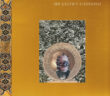
These days, solo project Candlesnuffer is fulfilling the same role for him. On 2003’s eponymous CD, electric guitar sounds were digitally processed beyond recognition into brutal noisescapes and more delicate, sinewy compositions. Like his work in the trio, he frequently draws startling sounds from an electro-acoustic guitar.

“Candlesnuffer can really go all sorts of places,” he said. “I’m fascinated by… juxtaposing high art and low art, analogue technology and digital technology, acoustic music and electric music, formal music and abstract music.”

While many of the bands Brown has been involved in have been celebrated in select circles, none has quite succeeded in paying the bills. Brown still works five days a week in a bookstore. Despite this, he rejects the notion of compromising his music in an effort to reach a wider audience.

“I can’t go and play in, like, a funk band a couple of nights a week for money,” he explained. “I’ve always been a bit of a purist. It’s not to say I couldn’t do that, but I could probably only do it for a very short period of time before it started to drive me crazy. It’d be like me as a painter doing layout for a newspaper. It would be another job.”

If these words came from the mouth of a young man you might dismiss them as undergraduate posturing, but Brown has been sticking to his principles and refusing to dumb things down for close to three decades now.

Brown’s definition of success is disarmingly simple.

“I just like to be happy with any given performance,” he said. “And that’s hard because I’m also full of self-doubt, and always have been.”

Wondering if it’s any good is an abiding anxiety for most artists, but with Brown you get the sense that recurring battles with his own inner demons have thwarted his ambitions at times. Now approaching 50, it is a part of himself he has come to terms with.

“Ideally, what I’d like is to be able to exist in some sort of a way that is self-sufficient, doing what I want to do, and not doing a whole lot of shit I don’t want to do. And I feel a lot more determined lately about that. But it’s a slow process,” he said.

The answer may lie in Europe. Pateras/Baxter/Brown toured ten countries there last year, and were well received by audiences and the music press. Wire writer Dan Warburton listed a performance by the trio as one of his highlights of 2004. Brown observed a greater acceptance of experimental music in Europe, as well as a stronger tradition of playing it.

“I still feel like for a lot of people [in Australia] it’s weird music,” he said of the trio’s work. “Something that Pateras/Baxter/Brown talk about is that we’re an improvised band, but that we’re trying to refine a method of instantaneous composition that is strongly influenced by European formal music as much as it is by improvisation.”

In the short term, Brown is set to release the second Candlesnuffer album, and a CD in collaboration with David Wadelton, titled Morpho. He said they had initially hoped to reform Signals, but third member Chris Knowles was unavailable.

Characteristically, the musical reunion has been no mere nostalgia trip, but a chance to explore something new, this time a loving deconstruction of sixties pop and porno funk. It as though Brown is psychologically incapable of covering old ground.

For all the hard slog of working in obscurity and playing to small audiences all these years, it is hard to imagine him being satisfied in a band like AC/DC, despite the millions that would have flowed his way. Playing variations of the same song over and over for thirty years, well, that’s just a bit unambitious, really.